Equipment metrology management: from the calibration schedule to impact analysis
A measuring instrument comes back from calibration with a verdict: out of tolerance. The question is no longer "when should it be checked again" but "since when has it been drifting, and which lots were accepted with it in the meantime". That is where metrological control is won or lost: not in the schedule, but in the ability to scope the impact. Here is what the regulations expect, and what you need to put in place.
What do the regulations require?
The requirement is not about a calibration calendar, but about whether a measuring device can produce valid results, and about what you do when it cannot. Three terms come up, often used interchangeably.
- Calibration
- An operation that establishes the relationship between an instrument's readings and reference values, under specified conditions. A calibration tells you the measurement error; on its own, it does not mean that the instrument is accepted for its intended use.
- Verification
- Confirmation, backed by evidence, that specified requirements have been met. For measuring equipment, it compares the results with the acceptance criteria defined in order to decide whether it remains fit for its intended use.
- Out-of-tolerance equipment
- Equipment whose condition no longer meets the specified requirements. The problem does not stop at the instrument: you have to assess the validity of previous measurements and determine which products, lots or decisions may have been affected.
| Framework | What it requires in practice |
|---|---|
| ISO 13485 (clause 7.6) | Control the measuring equipment needed to demonstrate conformity: identify it, define the checks, keep track of its status. And, when a piece of equipment is out of tolerance, assess and record the validity of previous measurements, then act on the equipment and on the products affected. |
| MDSAP (ISO 13485 audit) | There is no universal "one-year" interval. The initial frequency often starts from the manufacturer's recommendation, then is adjusted based on experience, with a documented justification whenever it changes. |
| QMSR / CSA (FDA 2026) | Software used for metrology, production or the QMS is part of the system to be controlled: defined intended use, assurance proportionate to risk, effort focused on the functions whose failure could affect the product. |
Operational summary: it replaces neither reading the texts nor the opinion of your regulatory affairs lead.
What should you do?
An equipment record should support a decision, not just keep an inventory. Here is what your organization must be able to do, whatever tool it chooses.
- Describe, for each measuring device, its use and the criteria that make it fit for product decisions, not just an internal number and a next due date.
- Make the status readable at the workstation: an out-of-service instrument must never be mistaken for a usable one.
- Define and justify the interval from the manufacturer's recommendation, the use, the risk and the observed stability, rather than an "annual by default".
- Link each piece of equipment to the production runs and inspections it actually served, to scope the impact of a drift.
- When an out-of-tolerance result comes in, assess and record the validity of previous measurements, identify the lots exposed since the last acceptable condition, then decide on actions for the equipment and the product.
- Control your calibration provider and decide yourself whether to accept the certificate: outsourcing calibration does not outsource the quality decision.
In Arianis, equipment stays linked to production
Arianis lists critical equipment, tracks its metrology schedule and keeps it within the same scope as inventory and production. The benefit shows on the day a piece of equipment has to be investigated: the production data is still there to find the lots concerned.
- Equipment listed with its status and metrology schedule.
- Alerts for equipment coming due.
- Equipment tracked within the same scope as production runs, with its usage history.
- Backward and forward traceability to support impact analysis; exports for audits.
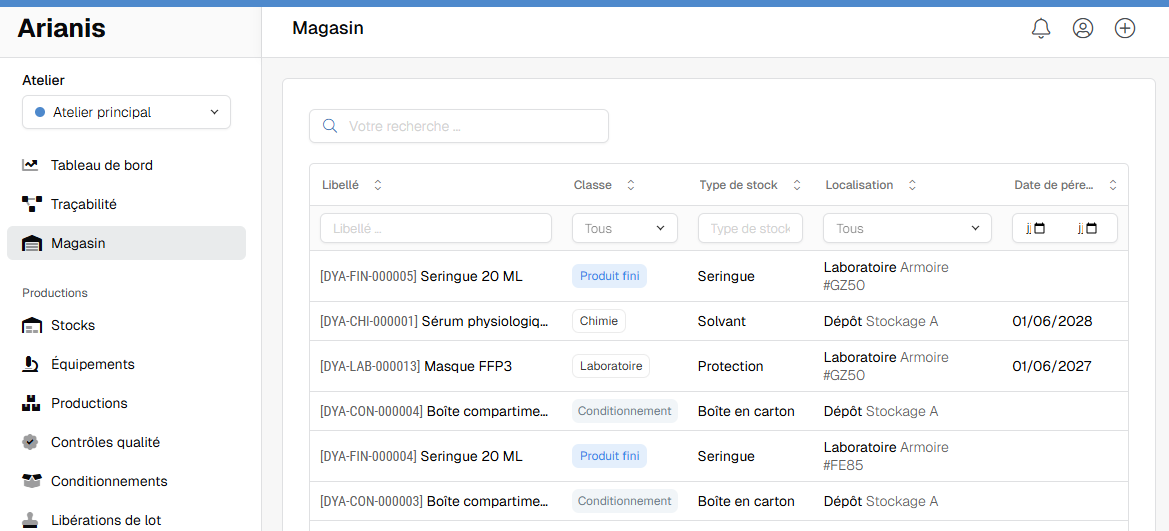
The Cerebellis software related to this topic

Further reading
Computerized system validation (CSV) according to GAMP 5
Software categories, V-model, risk analysis and traceability matrix: how GAMP 5 structures a risk-proportionate computerized system validation.

Production management software for medical devices: what evidence should it create?
Batch record, actual consumption, inspections, equipment, deviations and release: what production software must help you demonstrate in a medical device or IVD environment.

Medical device traceability: reconstruct a lot in seconds
What ISO 13485 and the MDR require of lot traceability, the six practical requirements to meet, and a simple test to see where yours stands.