Production management software for medical devices: recording what actually happened
An auditor opens a batch record at random and asks a simple question: show me what happened. Which instruction applied, which materials were actually consumed, which inspections were performed, on what evidence the lot was released. Production software is not primarily there to plan; it is there to answer that question, lot after lot. Here is what the regulations expect, and what you need to put in place.
What do the regulations require?
The regulatory need concerns the process and its evidence, not a software category. Building a set of requirements around the word "MES" means building it backwards. Three terms frame the subject.
- Batch record
- All the records your organization keeps to demonstrate what happened during the manufacture and inspection of a lot: materials and lots consumed, actual quantities, inspections, equipment, operators, dates, deviations, release decisions. Its content depends on the product, the process and your quality system; there is no universal template.
- Production record
- Evidence created during or at the end of an operation. The distinction that matters is between the instruction (what was supposed to be done) and the record (what was done). An up-to-date instruction does not, on its own, demonstrate that a lot was manufactured in accordance with it.
- DHR
- Device History Record, a legacy term from the former US Quality System Regulation. Since 2 February 2026, the QMSR no longer keeps it as a separate category: many of the elements once associated with it now sit in the device or batch records provided for by ISO 13485. The need for evidence remains; the regulatory vocabulary has changed.
| Framework | What it requires in practice |
|---|---|
| ISO 13485 | Identification and traceability within the defined scope, production controls, control of equipment, controlled records. No "MES" category is imposed: it is the processes and the evidence that are regulated. |
| MDR 2017/745 & IVDR 2017/746 | Controlled production, traceability to the defined extent, the UDI system. The texts ask for results and evidence, not for a type of software. |
| FDA QMSR (2 February 2026) | Incorporates ISO 13485:2016 and no longer keeps the DMR, DHF and DHR as separate record categories. The need for evidence remains; beware of regulatory matrices copied before 2026 that still cite 820.70, 820.181 or 820.184. |
Operational summary: it replaces neither reading the texts nor the opinion of your regulatory affairs lead.
What should you do?
The core of a useful batch record is to show what actually happened next to what was planned, and to keep deviations instead of overwriting them. Here is what your production must be able to demonstrate, whatever the tool.
- Record the actual next to the planned: instruction version used, lot and quantity actually consumed, inspection result, operator, equipment, date.
- Let the instruction itself trigger the record, rather than having the operator fill in a separate form: this is what makes the genealogy usable without recompiling it.
- Trace actual consumption, partial consumption included; a global decrement by item number creates no genealogy.
- Link the relevant equipment to the operations, so that you can find the lots concerned if the condition of a piece of equipment is called into question.
- Record deviations when they occur, without rewriting the instruction after the fact.
- Keep a batch record that remains exportable and readable for its entire retention period, and control every interface: data copied by hand from one system to another is a point of divergence, not an interface.
Arianis handles production execution and its evidence
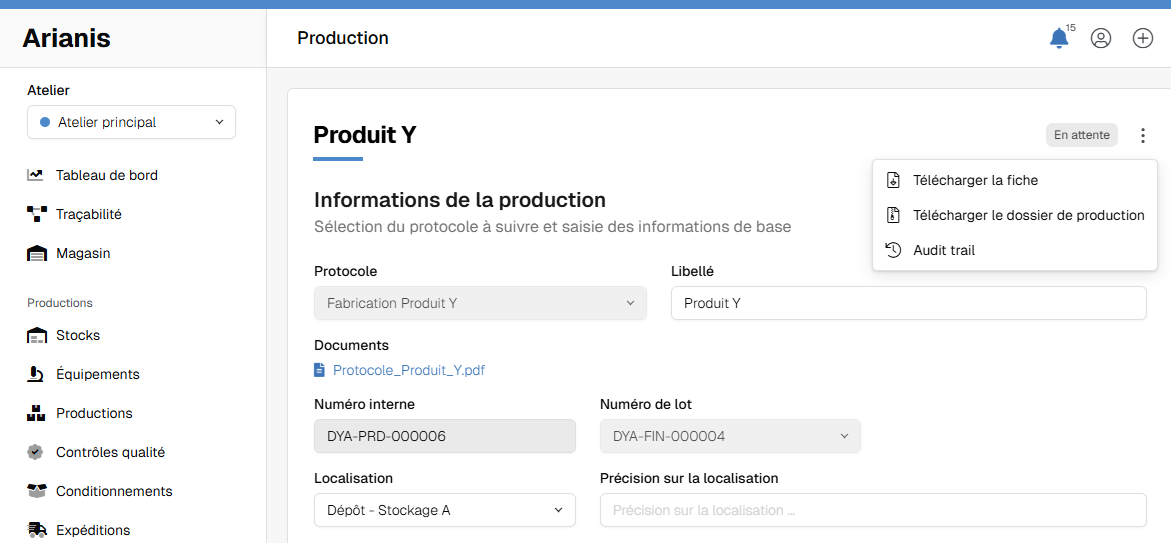
Arianis links protocols, inventory, production runs, inspections, equipment, labeling and traceability within the same scope. The aim is not to replace your ERP or your quality system, but to record what actually happens at the moment it happens.
- Configurable protocols with built-in controls; guided production runs and actual consumption recorded by lot.
- Deviations justified during execution, exportable batch records.
- Inventory, expiry dates, equipment and labeling/UDI tracked within the same scope as production.
- Backward and forward traceability, audit trail time-stamped by operator, native CSV exports.
The Cerebellis software related to this topic

Further reading
Computerized system validation (CSV) according to GAMP 5
Software categories, V-model, risk analysis and traceability matrix: how GAMP 5 structures a risk-proportionate computerized system validation.
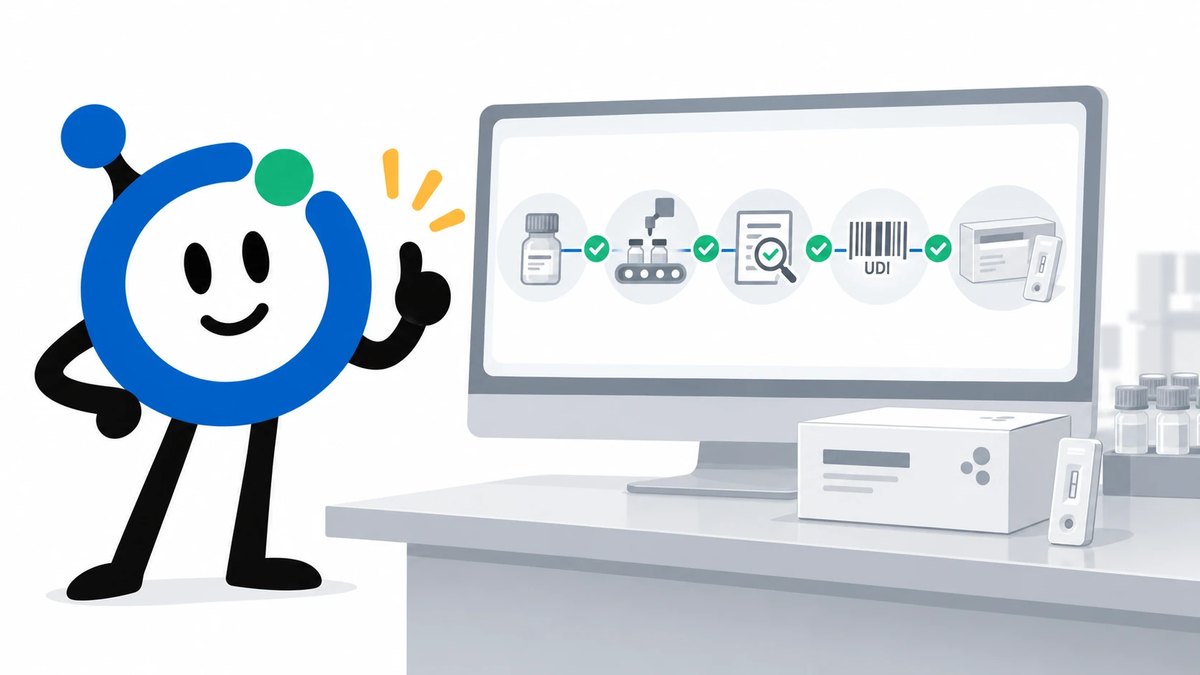
IVDR software for IVDs: production, traceability and quality under Regulation 2017/746
Classes A to D, performance evaluation, PMPF, 2027-2029 transitions, UDI and EUDAMED: what the IVDR changes for the data of an IVD manufacturer.
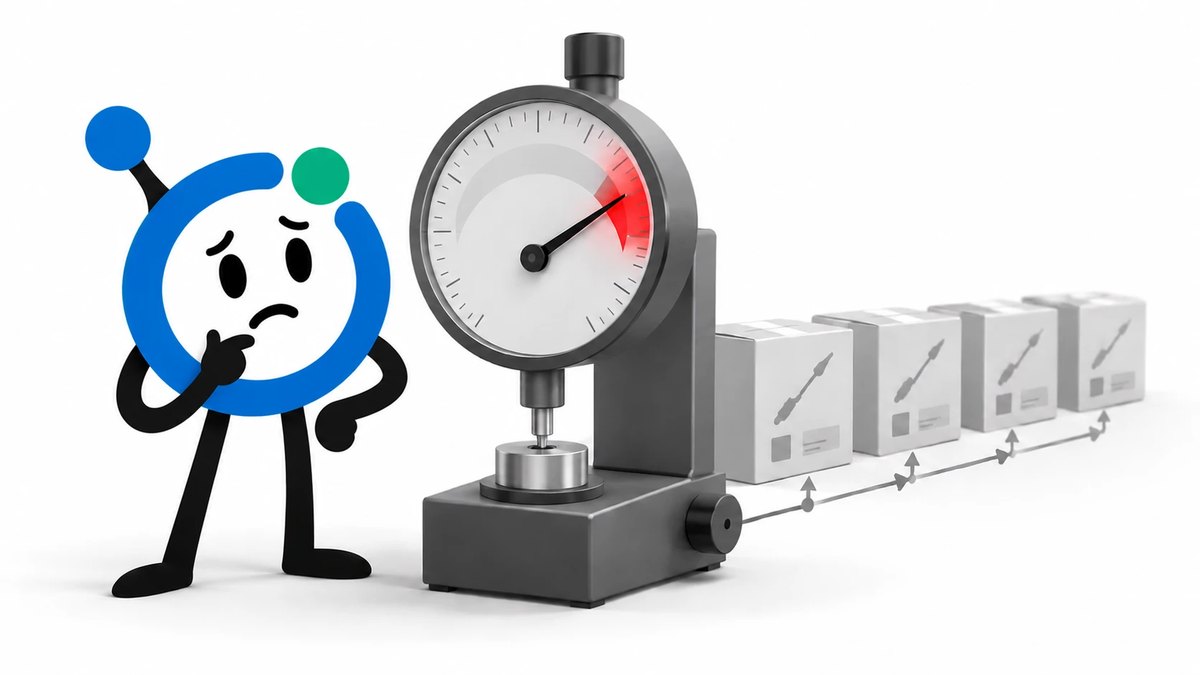
Equipment metrology management: the real issue starts when an instrument drifts
Calibration, verification, intervals and out-of-tolerance results: controlling measuring equipment and immediately finding the lots that may be affected.