IVDR software for IVDs: linking production, traceability, performance and surveillance without mixing them up
Many teams approach the IVDR with MDR reflexes. That is a trap: classification, performance evidence and the transition timeline each follow their own logic. Useful software supports the data of an IVD's life cycle (production, lots, traceability) without claiming to classify the device, build the performance evaluation or make regulatory decisions on the manufacturer's behalf. Here is what the IVDR expects, and what you need to put in place.
What do the regulations require?
The IVDR replaced the IVDD's category system with a risk-based classification, stronger performance evidence and a transition timeline with milestones. Three notions frame the subject before getting into the data.
- Intended purpose
- The use for which the device is intended according to the manufacturer's information: label, instructions for use, promotional material, statements made in the performance evaluation. It is what governs the qualification of the product, its classification and the performance evidence to be gathered, not the mere fact of being used in a laboratory.
- Classes A, B, C and D
- The four IVDR risk classes, assigned according to the rules of Annex VIII and the intended purpose, from A (lowest risk) to D (highest). There is no reliable conversion from an IVDD category to an IVDR class: the classification must be redone according to the rules of the regulation.
- Performance evaluation
- An ongoing process that establishes and analyzes the data demonstrating the scientific validity, the analytical performance and, where applicable, the clinical performance of the IVD. It is maintained throughout the life cycle, in particular using post-market surveillance information (PMS, PMPF).
| IVDR topic | What it requires in practice |
|---|---|
| Classification (Annex VIII) | Classify each IVD as A, B, C or D according to its intended purpose. No mechanical conversion from the IVDD: a product that used to be self-declared may now require a notified body. |
| Performance evaluation (MDCG 2022-2) | Demonstrate and continuously maintain scientific validity, analytical performance and, if applicable, clinical performance, fed by PMPF and PMS. Good analytical performance is not enough on its own. |
| Transitions & EUDAMED (as of 19 August 2026) | Conditional extensions until 2027-2029 for certain legacy devices; the IVDR QMS was expected from 26 May 2025 and some application milestones have already passed. On the EUDAMED side, four modules have been mandatory since 28 May 2026, with vigilance and performance studies still in development. |
Summary for orientation. Classification and deadlines are justified device by device, by applying the rules of the regulation.
What should you do?
Classification and performance evidence live in the regulatory documentation; manufacturing evidence is created in the stockroom, at the workstation and at inspection. Here is what your organization has to keep up, whatever the tool.
- Start from the intended purpose, then classify according to Annex VIII, never by carrying over the old IVDD category or a competitor's class.
- Track the transition status device by device, not by commercial family, and without deducing everything from a general date.
- Link each manufactured lot to its reagents, components, supplier lots and expiry dates, and keep the protocol version used.
- Record inspections (value, author, date, equipment) and link equipment to production runs, to scope an impact analysis.
- Generate the UDI and labeling from the lot's actual data, without re-entry; keep backward and forward traceability to investigate a lot under complaint.
- Keep regulatory exchanges (EUDAMED) configurable: do not hard-code a transitional rule as if it were final.
Arianis for execution, Praeventis for the quality loop
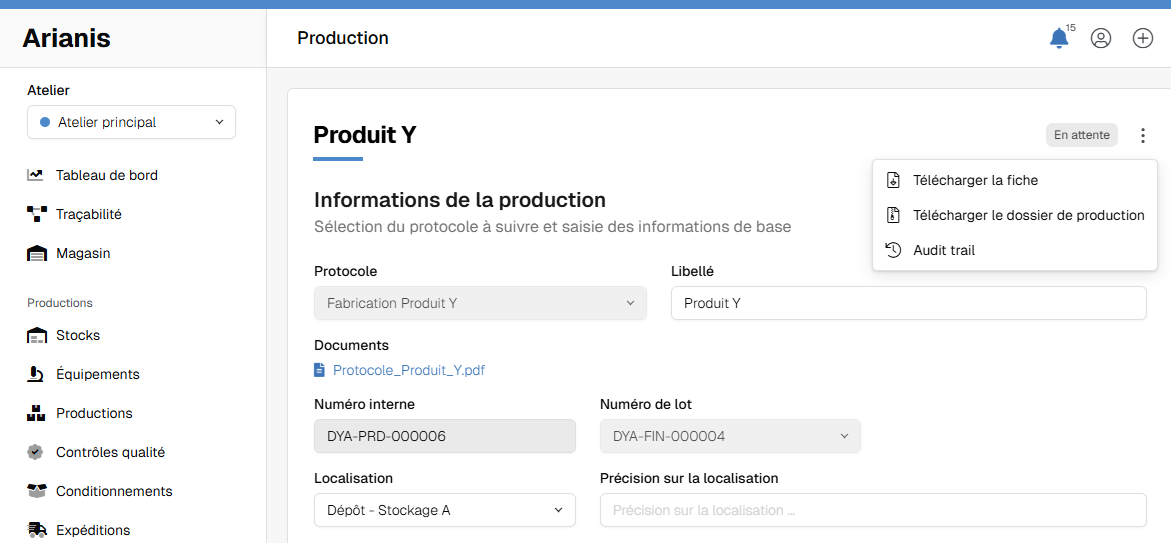
Arianis structures inventory, production runs, inspections, equipment, labeling and lot traceability. Praeventis structures incidents, deviations, CAPAs and quality actions. Together, they cover important operational data in an IVD's life cycle, without replacing the classification, the performance evaluation or the manufacturer's regulatory responsibilities.
- Reagent and component lots linked to production runs and their expiry dates.
- Guided production runs, inspections and exportable batch records; equipment and metrology within the same traceability scope.
- Labeling and UDI fed by the lot's actual data; backward and forward traceability for investigations and recalls.
- Incidents, CAPAs, actions and quality evidence tracked in Praeventis, linked to the lots concerned.
The Cerebellis software related to this topic


Further reading

Computerized system validation (CSV) according to GAMP 5
Software categories, V-model, risk analysis and traceability matrix: how GAMP 5 structures a risk-proportionate computerized system validation.

Producing PMS and PSUR reports without rebuilding the data by hand
A PSUR links exposure, incidents, trends and actions. Why this data lives in two systems, production and quality, and how to bring it together to produce the report without re-entry.

Medical device traceability: reconstruct a lot in seconds
What ISO 13485 and the MDR require of lot traceability, the six practical requirements to meet, and a simple test to see where yours stands.