Producing PMS and PSUR reports without rebuilding the data by hand
Every year, the same story: the PSUR deadline approaches, and the quality team spends weeks piecing together sales volumes, incidents, CAPAs and lot numbers scattered across several files. The report eventually comes out, at the cost of a manual reconstruction that proves very little. The real problem is not the writing: it is that the data the report needs lives in two different worlds. Here is which ones, and how to bring them together.
What do the regulations require of the report?
The full PMS and vigilance framework is covered in a separate guide; this one focuses on the report itself. The MDR and the IVDR do not expect prose from it, but an assembly of connected data. Three pieces of that data deserve a definition.
- PSUR
- Periodic Safety Update Report: the periodic safety update report required for MDR devices of classes IIa, IIb and III and IVDR devices of classes C and D. It is not written from scratch: it assembles and connects data already produced over the year (other devices fall under the lighter PMSR).
- Exposure data
- The denominator of the report: sales volumes or units made available, an estimate of the user population and, where possible, of the frequency of use. Without it, a number of incidents never becomes a rate: ten incidents out of a hundred units or out of a hundred thousand do not lead to the same conclusion.
- Trend reporting
- The mechanism that detects a statistically significant increase in frequency or severity, based on indicators and thresholds defined in advance. It is not a summary of every incident: it is an alert rule, which must exist before the signal arrives.
| Report component | What it contributes, and where it comes from |
|---|---|
| Exposure (the denominator) | Sales volumes or units made available, an estimate of the population and of the frequency of use. Without it, no rate can be calculated. It is created in the production system, not in the quality system. |
| Quality signals | Incidents, complaints, investigations, CAPAs, FSCAs and the effectiveness of actions. They live in the quality system and must stay linked to the device and lot concerned. |
| Analysis & conclusion | Trends (indicators and thresholds defined in advance), conclusions on the benefit-risk ratio, main findings of the PMCF or PMPF. It is cross-referencing the two previous sources that makes it possible. |
Operational summary of the expected content (Article 86 of the MDR and Article 81 of the IVDR). It replaces neither the texts nor the opinion of your regulatory affairs lead.
What should you do so that the report comes together?
A PSUR is prepared all year round, not the day before the deadline. That means the data has to arrive already linked together. Here is what your organization has to keep up, whatever the tool.
- Link each incident and complaint to the device, model and lot concerned, so that signals can be cross-referenced with exposure.
- Keep usable exposure data (volumes produced and made available, taken from the production system) rather than an estimate rebuilt at the end of the year.
- Record CAPAs and their effectiveness checks linked to the originating event, with owner, deadline and evidence.
- Define trend indicators and thresholds in advance, so that the report observes a change instead of discovering it.
- Keep stable identifiers (device, lot, event) shared between the production system and the quality system, so that matching them is not done by hand.
- Export structured data from both sides to prepare the PMSR and the PSUR without large-scale re-entry, while keeping the justification for decisions.
Praeventis and Arianis feed the same report, each its own half
Arianis handles production, lot traceability and exposure; Praeventis handles incidents, CAPAs and quality decisions. Linked by shared identifiers, they provide the two halves of the PMS file without double entry or a year-end reconstruction. Neither of them writes the report or decides on reportability for you: they keep the data usable.
- Arianis: volumes produced and made available, backward and forward lot traceability, inspections; the exposure data and the link to manufacturing.
- Praeventis: incidents, complaints, CAPAs, FSCAs and effectiveness checks, with owners, deadlines and history.
- Shared lot and device identifiers: a quality signal links to the manufactured lot without manual cross-referencing.
- Structured exports on both sides to assemble the PMSR and the PSUR, and to prepare the review throughout the year.
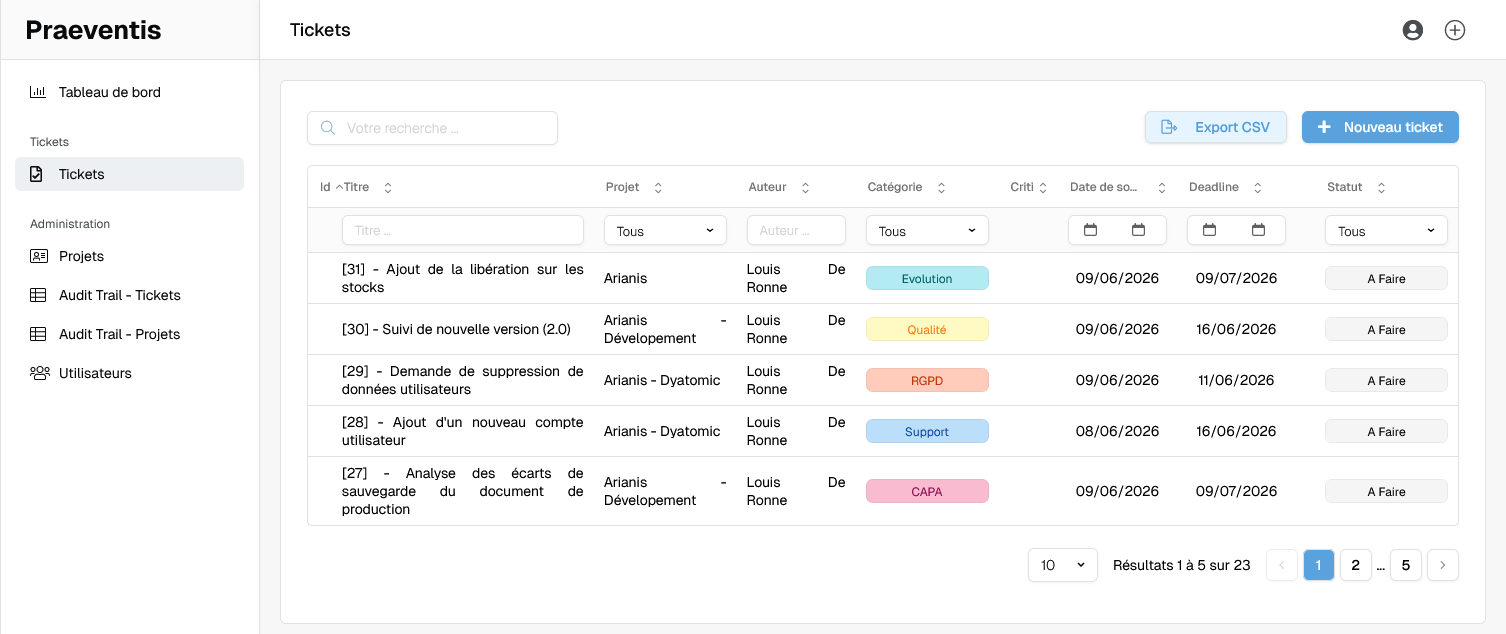
The Cerebellis software related to this topic


Further reading

Computerized system validation (CSV) according to GAMP 5
Software categories, V-model, risk analysis and traceability matrix: how GAMP 5 structures a risk-proportionate computerized system validation.

IVDR software for IVDs: production, traceability and quality under Regulation 2017/746
Classes A to D, performance evaluation, PMPF, 2027-2029 transitions, UDI and EUDAMED: what the IVDR changes for the data of an IVD manufacturer.

Medical device traceability: reconstruct a lot in seconds
What ISO 13485 and the MDR require of lot traceability, the six practical requirements to meet, and a simple test to see where yours stands.