UDI labeling: what the MDR requires, and how to produce it without re-entry
People talk about "the UDI" as if it were a code to stick on a label. It is in fact a system of complementary identifiers, and its production part is created during manufacturing, which is exactly where labeling errors appear. Here is its structure, the recognized formats, and how to produce labels without re-entering data.
What do the regulations require?
Most misunderstandings come from a shortcut: people talk about "the UDI" as a single identifier, when it is an assembly whose parts each have a different lifespan. Three of them need to be defined first.
- UDI-DI
- The Device Identifier: a fixed value specific to a device at a given packaging level. It appears on the label. A new UDI-DI is required in particular when a change could lead to misidentification or ambiguous traceability (cases detailed in the MDCG 2018-1 guidance).
- UDI-PI
- The Production Identifier: the variable part, made up of the production identifiers that apply to the device. Depending on the case, it carries the lot number, the serial number, the software version, and the manufacturing and/or expiry date; not all of these are present at the same time. It is created during manufacturing.
- Basic UDI-DI
- A documentary key that links, in the European database and in the regulatory documentation, the devices sharing the same intended purpose, risk class and essential design and manufacturing characteristics (MDCG 2018-1). It appears neither on the device nor on its label: it ties the device to its declaration of conformity, its certificates, its technical documentation and its EUDAMED record.
| UDI topic | What it requires in practice |
|---|---|
| UDI structure | The UDI on the device = UDI-DI (fixed, on the label) + UDI-PI (variable: lot, serial number, dates, software version as applicable). The Basic UDI-DI is a documentary key that stays off the label. The UDI-DI and the UDI-PI both appear on the carrier. |
| Carrier & formats | A carrier readable by machine (AIDC) and by a person (HRI), subject to the exceptions in Annex VI, compliant with the system of your issuing entity. The Commission has designated GS1, HIBCC, ICCBBA and IFA GmbH until 27 June 2029. |
| EUDAMED & deadlines | Use of the UDI/device module has been mandatory since 28 May 2026. The labeling deadlines are mostly behind us (class I since 26 May 2025) but still need checking product line by product line and according to the regulation that applies (MDR or IVDR). |
Operational summary: it replaces neither reading the regulation nor the opinion of your regulatory affairs lead. Status as of 19 August 2026.
What should you do?
A UDI labeling error is almost never a misreading of the regulation. It is a data flow error. Here is what your labeling chain must guarantee, whatever the tool.
- Build the UDI-PI from the lot's actual data, without re-typing the lot number or recalculating the dates separately.
- Reserve lot numbers upstream, so that the same number cannot be assigned twice across parallel production runs.
- Centralize and version the label templates, identical on every workstation.
- Give each packaging level its own UDI-DI, except purely logistical shipping containers.
- Check consistency before printing, not after the label is applied, and make sure the carrier bears both the AIDC and the HRI (subject to the exceptions in Annex VI).
- Keep EUDAMED up to date and check the deadlines product line by product line, depending on whether the product falls under the MDR or the IVDR.
Generate the label from production data
Arianis produces labels from the lot itself: the production identifiers never pass through another tool, so nothing is re-entered.
- Labels and UDI identifiers configurable for your issuing entity, in multiple formats (linear barcodes, DataMatrix, QR).
- Lot numbers reserved in advance, to avoid duplicates across parallel production runs.
- Unit serialization and multi-level packaging; packaging and release in the same flow as manufacturing.
- Labels generated from the lot, without re-entry; from a printed identifier, the lot's full genealogy remains accessible.
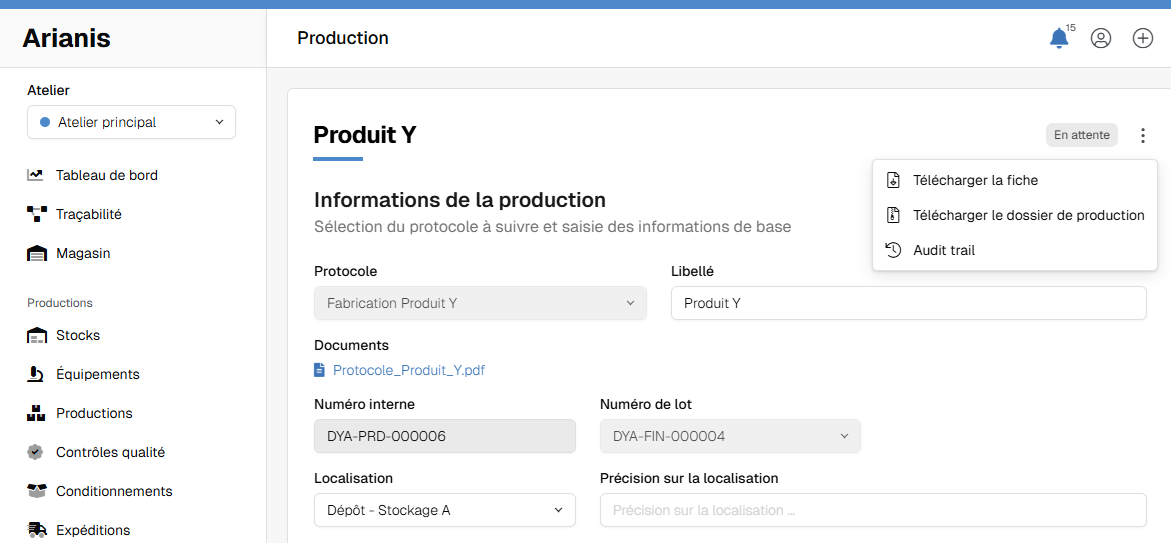
The Cerebellis software related to this topic

Further reading

Medical device traceability: reconstruct a lot in seconds
What ISO 13485 and the MDR require of lot traceability, the six practical requirements to meet, and a simple test to see where yours stands.
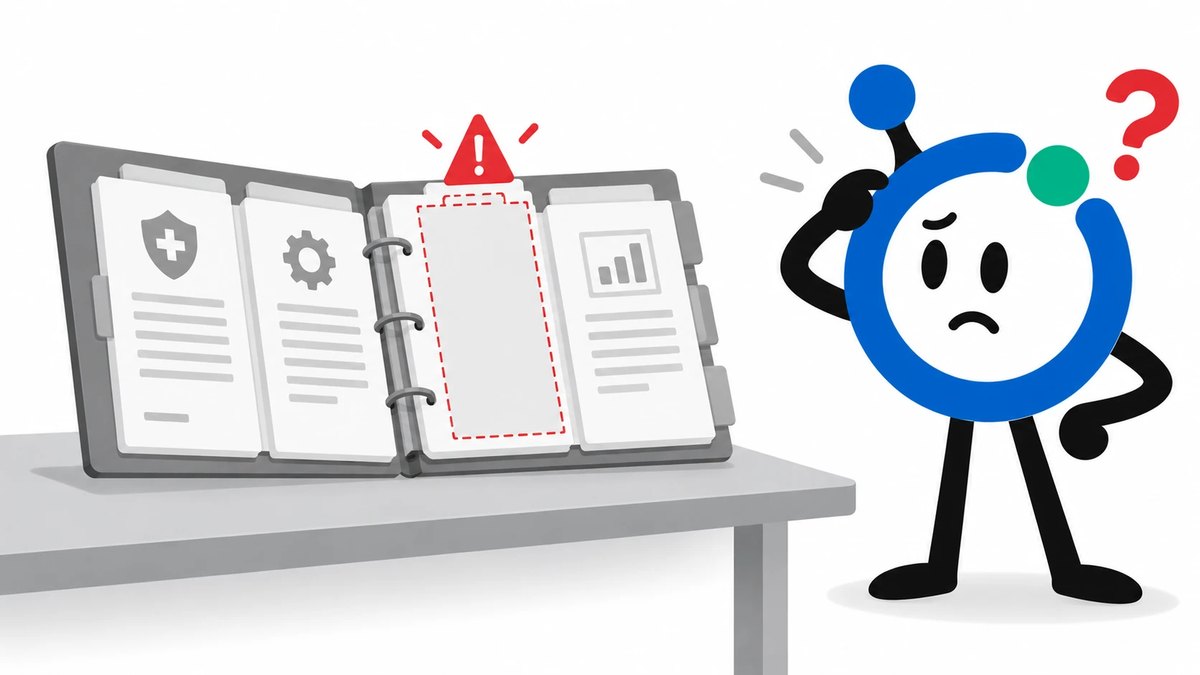
A finding from notified bodies, critical consequences for MedTechs, a situation you can anticipate
A 2024 survey conducted for the European Commission shows that fewer than half of the files received by MDR notified bodies are complete on receipt, and a lack of traceability is a major cause.
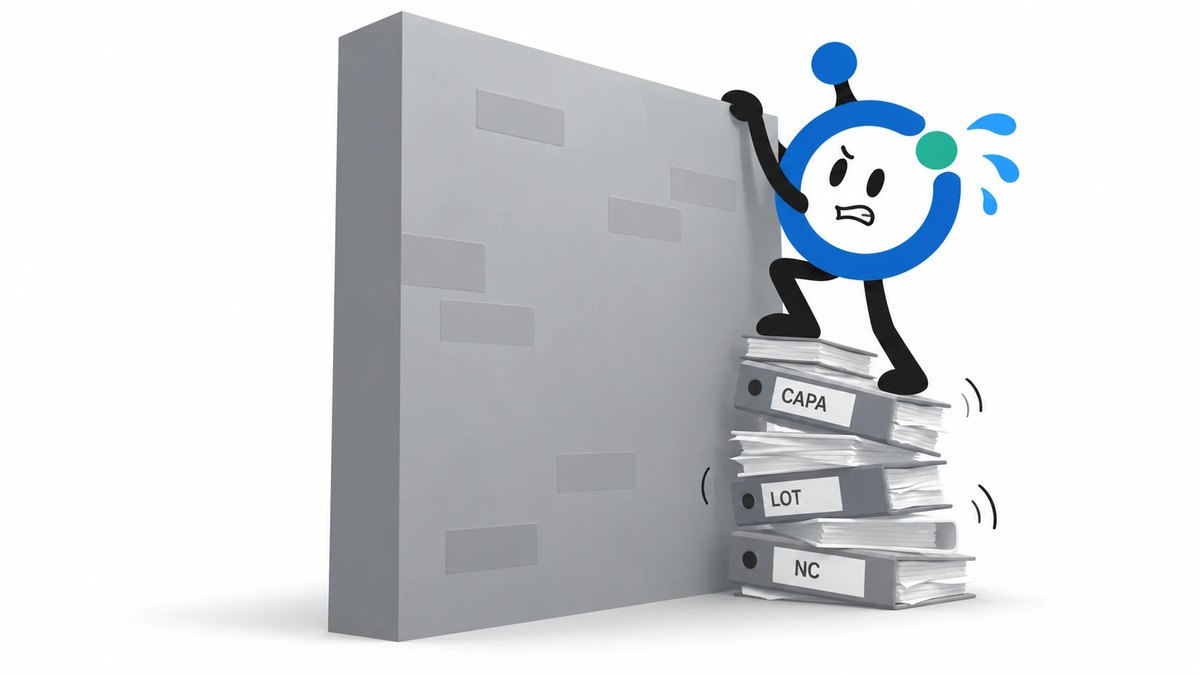
What is the Scaling Wall in MedTech?
The real brake on MedTech growth is not the market but the methods: without digital traceability in the QMS, growth hits a methodological wall.